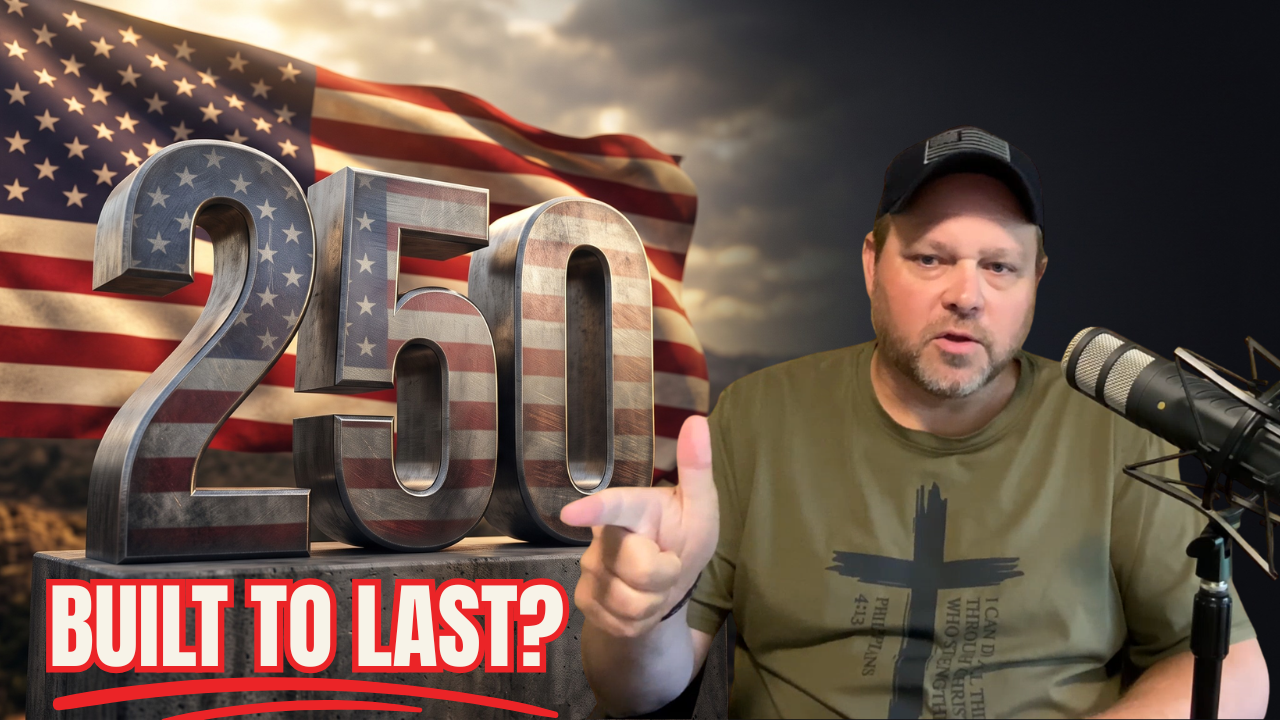

This week, America turns 250. Something lasted two and a half centuries, and it wasn't by accident or luck. It survived because it was built to handle friction, growth, and change—which is exactly what your business needs to do if you want it to last.
The official word for a 250th anniversary is semiquincentennial. That is a real word. It sounds like a dinosaur, a medical condition, and a spelling bee final boss all at the same time. But forget the word. Here is the part worth paying attention to. Something lasted 250 years. Most things don't. Most companies don't make it past ten. Most teams don't survive a single bad season together. So when something stands for two and a half centuries, that is worth a closer look. Not for the fireworks. For the lesson underneath them.
Because the thing that lasted was not a building or a flag. It was something bigger, built by a group of people who had to figure out how to work together. And that should be the focus in your business too.
The Parable of the Growing Town
A founder builds a company like a town. At first, it was small. Six people. Maybe eight. Everybody knows everybody. The rules are informal. People pitch in wherever they are needed. A problem comes up, you solve it in the moment, usually in the truck or the parking lot. There is no handbook because you don't need one. The whole thing runs on memory, personality, and the founder's gut. And it works. At that size, it works great.
Then the town grows. Now there are more crews. More trucks. Customers the founder has never met. New people who were not there at the beginning and have no idea how it used to be. There are standards to hold and deadlines to hit and disagreements that don't get solved informally anymore.
Let's look at the operational reality. You get a call from a furious customer. Why? Because a new crew leader did the job the way he did it at his last company. He didn't know your standard. Why didn't he know your standard? Because your standard only exists inside your head. You never wrote it down. You never trained him on it. You just assumed he would absorb it through the air.
And here is what the founder says. Every single time. "I just want it to run like it used to." I get it. I do. But that is not how growth works.
When the town was six people, it could run on intuition. When the town is sixty people, intuition will sink it. If a town wants to last, it needs roads. Signs. Shared rules. Leaders who are not just the founder. A way to handle disagreement that does not depend on everybody being in the same room. That is not bureaucracy for its own sake. I am not telling you to turn your company into the federal government. Please don't. Nobody got into business because they love paperwork.
But hear me on this. If you want your company to last, you cannot run it forever on memory, personality, and intuition. You have to build it on purpose. So let's talk about what that actually means.
Building a Team That Can Fight Well
Here is what people get wrong about 250 years of America. They think it lasted because everybody agreed. They picture the founders as a united team, all rowing the same direction, all friends.
That is not what happened. The founders argued constantly. They disagreed about almost everything. Some of them flat out could not stand each other. The early days were messy, tense, and full of conflict.
And it still held. Not because the disagreement went away. Because the thing was built to survive disagreement. What sustains a legacy is a team that can handle conflict without falling apart. Most owners get this exactly backward. They think a strong team is a quiet team. No friction. Everybody gets along. Nice and smooth. That is not strength. That is silence. And silence is where resentment grows.
Let me make it real for your world. Your field manager and your estimator butt heads over how long a job should take. They are arguing in the office. That feels like a problem to most owners. It is not the problem. That is two people who care about the work disagreeing out loud. That is exactly what you want.
The real problem is the 'polite' team. When everyone nods in a meeting, they aren't necessarily agreeing—they’re just avoiding the hard conversation. Later, that avoidance shows up as sloppy, inconsistent work, with three different people handling the same job in three different ways.
A team that fights well, early and clearly, is stronger than a team that is just being nice to each other. Healthy teams have the hard conversation sooner. Weak teams let it rot in silence until somebody quits or blows up.
So how do you execute on this? Stop trying to eliminate conflict. Start building a team that can have it like adults. Change how you run your meetings. Stop asking, "Does everyone agree?" That is a terrible question that invites silence. Start asking, "What are we missing?" Ask, "Who sees a problem with this plan?" Force the disagreement out into the open. Reward the employee who speaks up and challenges a broken process. Make conflict safe, and you kill the quiet resentment that destroys companies from the inside out.
The Power of Adaptation
Longevity requires constant adaptation. Nothing stays strong by coasting. Not a country, not a company, not a team. What worked for you five years ago will not carry you five years forward. The people change. The standards have to rise. The team you have today is not automatically the team you need tomorrow.
True adaptation means consistently upgrading how you operate, your processes, and your expectations. It is the intentional act of shedding old habits that no longer serve the scale of your operation. As your company matures, it must outgrow its early limitations to handle new complexities. You aren't just maintaining a business; you are evolving an organization that is more resilient and capable than the one you started with.
The Founder's Challenge
So here is what I want you to sit with this week. If your company had to last 250 years, what would need to be clearer, stronger, or healthier than it is today? You and I will not personally be around in 250 years. But the company can be built to run without you long before that. That is the whole point. George Washington could have held onto power until the day he died. He handed it off instead, because he was building something meant to outlast the people who started it.
Your company should be the same. If this thing had to outlive you, your memory, and your personality, what falls apart the second you step away? Does the hiring process collapse? Does the quality control vanish? Does conflict resolution turn into a shouting match? That answer, whatever it is, might be your next project. And this is something you want to build on purpose.
Build Something That Lasts
America at 250 is not a story about everybody agreeing. It is a story about a group of people who argued, disagreed, drove each other crazy, and built something anyway. Something that was designed to survive all of that. And it did.
You are not building a country. But you are building something. A team. A company. A standard that shows up on every job whether you are there or not.
It will not last on luck. It will not last on intuition. It lasts when you build it on purpose. If you look at your operations right now and realize your recruiting is just patching leaks, or your culture relies entirely on you being in the room, it’s time to upgrade how you operate. You need to build a team that can outlast the current season.
That is exactly what we do at BR1. We help leaders stop running on intuition and start running on the kind of foundation that attracts and retains the right people. If you want to become a sought-after employer that consistently attracts top-talent, let's talk.
Until next time, keep building your stronger team!