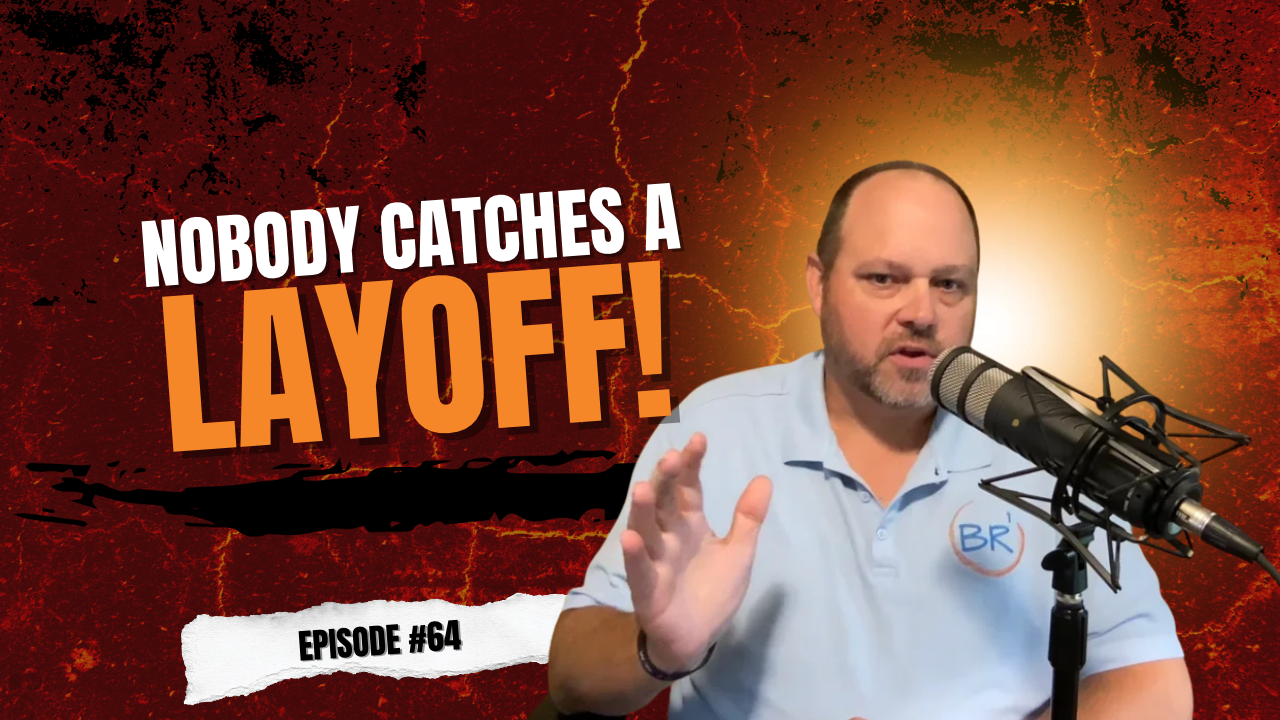

Open LinkedIn any morning and you'll see it. "I was impacted by the recent round of layoffs at..." Impacted. Like a hailstorm came through. Like the company caught the flu. Nobody catches a layoff. Somebody decides one.
Something's been bugging me this week, and I think it lands squarely on anybody who signs the front of a paycheck.
LinkedIn Posts
If you spend any time on LinkedIn, you know the post I'm talking about. Somebody got let go. They write a few gracious lines about how much they loved the team, how grateful they are for the experience, how they're excited about what's next. Open to work. Please share.
And what jumps out at me every time is the language. "Impacted by." "Affected by." "Part of a workforce reduction." Notice what's missing from all of them. Nobody's named. Nobody did anything. It just happened, the way weather happens.
Now, I want to be fair to the person writing that post, and then I want to move on from them, because they're not the problem.
That person is job hunting. They need the next thing. Bitter doesn't sell, and everybody reading knows it. So they write the gracious version, whether they feel it or not. That's not conditioning. That's survival. I'd tell a candidate to write it exactly that way.
So let's leave them alone. The question I'm actually asking is about the people who made the call.
Nobody catches a layoff
A layoff is not an event. It's the tail end of a decision.
Somewhere, twelve or eighteen months before that post gets written, somebody looked at a forecast and said yes. Yes to that many people. Yes to that growth number. Yes to opening the new branch, or chasing the contract, or staffing up for demand that was projected and not proven. And then the projection didn't hold.
Sometimes that's honest. Markets move. A customer walks. A material cost doubles. I'm not going to sit here and pretend every company that ever cut headcount is run by fools, because that's not true and you'd stop listening.
But the decision was still a decision. And the thing that bothers me is how completely that gets erased by the time it reaches the people on the receiving end. "Economic headwinds." "Right-sizing." "Difficult but necessary." Every one of those phrases is built to remove a person from the sentence. To turn a choice into a condition.
And if you say it that way long enough, from the top, in every all-hands meeting, in every press release, people start to believe it. Not just the ones who got cut. The ones who stayed. Everybody in the building learns that a job is something that can just disappear, and nobody has to answer for it. Whoops, my number came up this round. Better luck next time.
A career isn't supposed to be Russian roulette.
The Part Nobody Says in the Interview
Now let's talk about the version of this that actually makes me mad.
There are companies, and you know some of them, that hire to demand and cut to demand. On purpose. Business picks up, they staff up. Business dips, they let people go. Then it picks up again and they post the same job they eliminated six months ago.
Fine. If that's the model, that's the model. It's not illegal.
But nobody says that in the interview. Nobody puts it in the recruiting pitch. Nobody's careers page says "join a team that we'll thin out the minute the numbers soften." The careers page says family. It says we invest in our people. It says growth and development and long-term.
That's the gap. That's the failure. Not the cut. The distance between what somebody was told the day they said yes and what actually happened to them a year later.
And I'll say this about the recruiting business, because it's famous for exactly this. Every time we grow and need to hire another recruiter here at BR1, about 90% of the resumes we see are people with one-year stints at a dozen different agencies. Hired when the desk was hot, cut when it cooled off, on to the next one. And it makes it hard as hell to tell who's a job hopper and who's just been the repeated victim of a bad business. That's a big part of why we work so hard to make BR1 a different place to work for our own team. We've seen what the other version does to people.
What the Green Industry Gets Right
And here's where I'll bring it home to our world, because it's a place where the green industry is honestly ahead of a lot of the corporate world.
A lot of green industry companies still lay people off every year. Seasonal crews. Installation help that winds down in the fall. Snow and ice people who aren't needed in April. Now, I've spent plenty of episodes on this show pushing companies to build more year-round jobs, because that's what wins the best people, and I'm not walking that back. But here's what's worth noticing about the companies that are still seasonal: nobody writes a sad LinkedIn post about it. Nobody calls it a betrayal.
Why? Because it was said out loud at the interview. "This runs March through November. Here's what winter looks like. Here's who we bring back and how." The guy on the crew knows the deal before he starts. The expectation and the reality match.
That's the whole difference. A seasonal layoff isn't a betrayal, because it isn't a surprise.
So when I say layoffs are a failure, I don't mean reducing headcount is always a failure. I mean the surprise is the problem. Somebody who was told one thing finds out they were living under a different set of rules the whole time. And the other problem is how normal we've let it get. A layoff treated like business as usual, nothing to see here, back to work. That's a failure too.
So What Does This Have to do With You?
You're probably not doing a "round of layoffs" the way the tech companies do. But the same thing happens in our world. It just looks different.
It looks like hiring three guys in April because the pipeline looked huge, and cutting two of them in July because half the pipeline didn't close. It looks like promising a crew leader he's on track for an Operations Manager role and then quietly deciding you can't afford the role. It looks like telling a good foreman "we've got you through the winter" and then finding out in December that you don't.
None of those just happened to you. Every one of them started with a decision, and every one of them ended with somebody who was told one thing and got another.
Here’s What I’d Challenge You to do With This
First, be honest about what you're hiring for. If the role exists because of one contract, say so. If it's seasonal, say so. If you're staffing up ahead of growth you haven't landed yet, say that too. A good person will take a real answer over a nice one. What they won't forgive is finding out later. And when we're recruiting for a client, that honesty goes a long way with good candidates and the employer's reputation.
Second, if you ever do have to let somebody go for reasons that have nothing to do with them, own the decision when you do it. Not "the market." Not "circumstances." You made a call, it didn't work out the way you planned, and this is the result. That's a harder conversation. It's also the only one that leaves the person with their respect and leaves you with your credibility, with them and with everybody who's still on the crew watching how you handled it.
And third, when you're making the growth decision, the hiring decision, the yes decision, ask yourself who's going to pay if you're wrong. If the honest answer is "the three people I'm about to hire," then you're not taking a risk. You're handing them one. And owning that decision doesn't just mean taking responsibility if it goes wrong. It means working your ass off to make it go right.
The layoffs all over LinkedIn aren't out of leadership's control like the weather. They're what a decision looks like a year later, and somebody made it.
You're going to make that decision too. Maybe this year, maybe next. So make it with your eyes open, tell people the truth about it when you hire them, and if it goes sideways, put your name on it. That's not weakness. That's the difference between being a leader and being a meteorologist. The meteorologist just reports what happened. A leader owns the decision and whatever comes of it.
Until next time, keep building your stronger team!