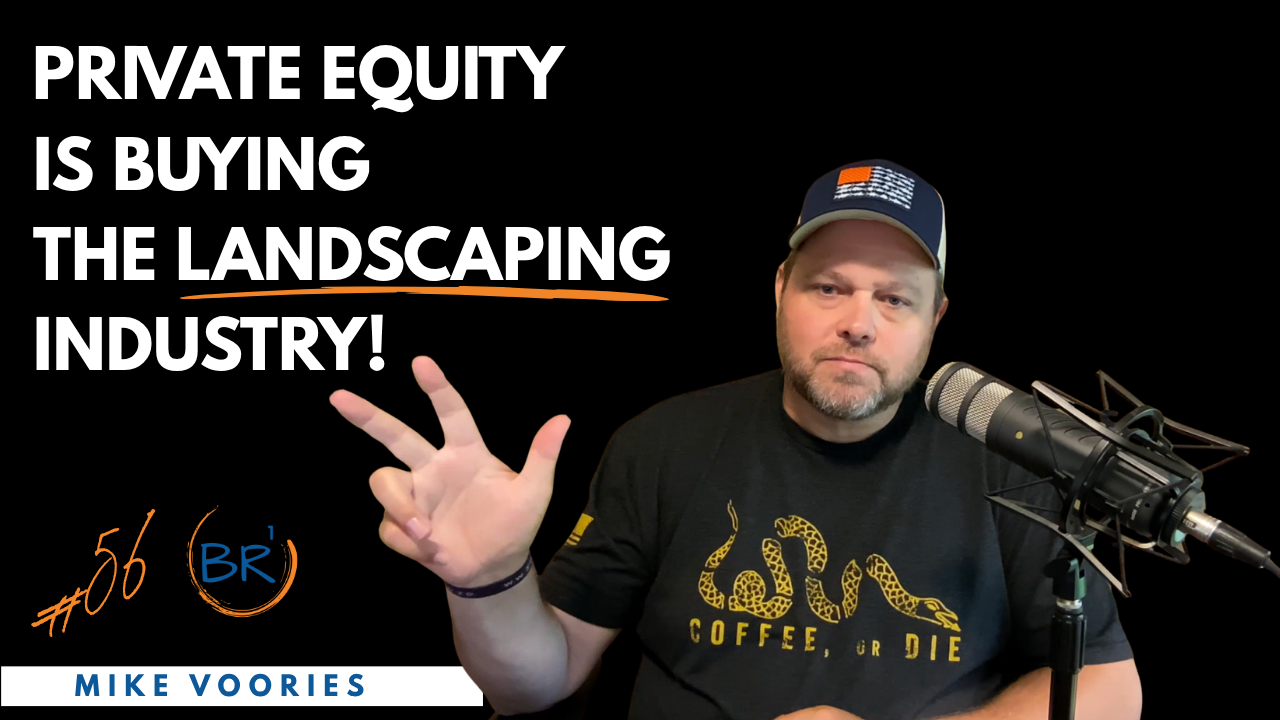

Every conversation about private equity in this industry is aimed at one person. The owner. When to sell. What price? Which partner? What's next for you? I want to talk about the people nobody is advising. And from where I sit, a lot of them are already halfway out the door.
I've spent about thirty years in the green industry. I've recruited a lot of people. I talk to a lot of owners and business leaders. And I also talk to a lot of team members.
And lately I am hearing something I have to tell you about.
The Private Equity Landscape
Private equity is the hottest topic in the green industry right now. It is not hype.
As of last fall, private equity made up about seventy-six percent of all landscaping M&A activity. Three out of four deals. There are hundreds of thousands of landscaping companies in this country. The industry's own association counts close to seven hundred thousand of them. Most are small. Most are family owned. No single company controls even five percent of the market. Fragmented ownership. Recurring revenue. Year-round demand. To a private equity firm, that is not grass. That is a buffet.
So if you own a company of any real size, you have probably gotten the call. Or you will.
And here is what happens next. You get advice. A lot of it. Bankers, brokers, attorneys, other owners who have done it. When to sell. How to clean up the financials. How to maximize your multiple. How to pick the right partner. What your earn-out looks like. What you will do with the rest of your life.
All of that advice points at one person. You.
Now let me tell you what I see.
The Blind Spot
When a candidate calls us wanting to make a move, or one of our recruiters reaches out to them with an opportunity, we always come around to the same question.
Why do you want to leave?
For years the answers were predictable. Pay. A bad boss. No room to grow. A long commute. Lately there is a new one. And it is coming up over and over. Private equity.
People are telling us, straight up, that their company got bought and now they want out.
Sit with that. The sale has not ruined anything yet. Nothing has officially changed. And the best people are already updating their resumes.
You cannot see that from the owner's chair. But I can see it from mine.
The Stakes
Here is the part that should stop you cold.
What did the buyer actually pay for? Not your logo. Not your trucks. They paid for recurring revenue, customer relationships, and crews who show up and do the work right. Every one of those things runs through your people.
The recurring revenue exists because a crew leader knows that property better than the client does. The customer relationship exists because your account manager has been picking up the phone for nine years. The reputation exists because your team built it, one job at a time. That value does not sit in a spreadsheet. It walks out the door on two legs.
And here is how these deals actually get paid. It is rarely all cash on day one. Part of your money comes later, and it rides on what happens after you sell. Sometimes that is an earn-out tied to performance. Often you are rolling some of your equity into the new company and keeping a stake. Either way, part of your payout now depends on how the business does after the closing. And how the business does depends on the team. If the team leaves, the number you were promised gets smaller.
So even if you only care about your own check, understand this. The team is the check.
The private equity firms know it too. Ask them and they will tell you loss of key talent is one of the biggest risks in any deal. They know. The question is whether you are doing anything about it before the closing, or just hoping it works out.
Four Things to Sit With
Let me give you a few things to consider. Some of these will be uncomfortable.
One. Your team can smell a sale before you announce it. New faces in the office. A closed door. The accountant showing up more than usual. People are not stupid. The silence you think is protecting them is actually scaring them.
Two. A retention bonus is not a strategy. It is a bribe with an expiration date. Your best people do not have a loyalty problem. They have an options problem. They have options everywhere. A check buys you their body for twelve months. It does not buy their belief.
Three. "Nothing is going to change" is the fastest way to lose trust. Because everyone in that room knows something is going to change. The day you say it and it turns out not to be true, you have taught your team not to believe you. And they will act on that.
Four. The first people to leave are the ones you can least afford to lose. Turnover in these situations is not random. It is sorted by talent. The people with the most options move first. The people with the fewest options stay. Think hard about what that does to a company over eighteen months.
What to Actually Do
So what do you do? I am not here to scare you out of selling. Selling can be the right move. A good partner can give your people more room to grow than you ever could on your own. I have seen that happen. This is not anti-private-equity. This is pro-team. But the good outcome does not happen by accident. Here is the shift.
Bring your key people into the conversation earlier than feels comfortable. Not the number. That is yours. But the why, and the what-happens-to-you. The people who matter most should hear it from you, in a room, before they hear a rumor in a truck.
Name your non-negotiables to the buyer. If keeping your team, your name, and your culture matters to you, that belongs in the deal conversation. The best acquirers in this space will tell you the team is the most important thing they are buying. The wrong ones give themselves away early. If a buyer is already talking about your team as a cost to cut, before they even own the place, believe them. How a buyer talks about your people before the deal is exactly how they will treat them after it closes.
Be honest about what you are really selling. You are not selling a business. You are selling the trust your people placed in you when they signed on. Handle that like it is worth something. Because it is.
See it Through Their Eyes
Before you close anything, do one thing for me. Stand in the boots of your best people for a minute. Your top crew leader. Your account manager. Your operations lead. Whoever your company would hurt to lose.
They have heard the whispers. They saw the closed door. They don’t know if their job, their crew, or their book of business is safe. Nobody has told them anything, so they’re filling the silence with the worst version of the story. That is not weakness. That’s what people do when they are left in the dark.
Now hear what that person is thinking. "The buyer needs me. That value they paid for is standing in my boots. I have options. I am not stuck." And here is the hard part for you. They’re right.
So put yourself on the other side of the desk. The people you most need to keep are the ones who feel the least certain and have the most options. They are not being disloyal. They are being smart. If you were sitting where they are sitting, you would be doing the exact same thing.
The owners who come through a sale with their team intact are the ones who saw this coming. They looked through their people's eyes early. They answered the questions before they got asked. What is my role? Who do I report to? What is the plan for my team? If you can answer those for your key people, and answer them honestly, you are already ahead of almost everyone who has done this.
A Final Word to the Owner
Here is where I will leave you.
The sale is about the owner. The outcome is about the team. Everybody is obsessed with the first one. Almost nobody is protecting the second.
If you are thinking about selling, don’t wait for the deal to force the conversation. Go look through your best people's eyes this week. Before the rumor does it for them.
One honest word about what we do, because this is the moment we’re built for. Before a deal, we help owners hold onto the people who make the company worth buying. After a deal that someone else handled badly, we help their best people find a better seat. Both of those are our work. If any of this is on your desk right now, BR1 can help.
Build a team worth buying, whether you ever want to sell it or not. Then be the kind of leader worth staying for.
Until next time, keep building your stronger team!